
Turnkey Projects — Specialists in Industrial Development and Nearshoring
Tijuana as an extensión of California for digital infrastructure:
The rapid growth in demand for digital infrastructure along the U.S. West Coast is placing increasing pressure on key markets such as Los Angeles, Orange County, and Silicon Valley.
Clear constraints include:
-
- Power saturation
- Land scarcity
- High costs
- Regulatory restrictions
Within this context, Tijuana is emerging as a compelling edge market, supported by technical fundamentals worth close examination.
– – – – – – – – –
Latency: Real viability for sensitive workloads.
The viability of any data center market begins with one key factor: effective latency to critical nodes.
-
- Tijuana – San Diego distance: ~30 km
- Estimated fiber latency: 2–5 ms RTT
This performance positions Tijuana competitively against routes such as:
-
- Los Ángeles ↔ San Diego (~3–5 ms)
- Los Ángeles ↔ Silicon Valley (~8–12 ms)
– – – – – – – – –
What does this mean in practical terms?
Tijuana is not a secondary market. It is a location capable of supporting production-level operations for:
-
- Edge computing
- AI inference workloads
- Content delivery networks (CDN)
- Low-latency gaming
- Cross-border hybrid architectures
It is an operationally viable production market.
– – – – – – – – –
Connectivity: International-grade backbone infrastructure
The California–Baja California region benefits from one of the most robust network ecosystems on the Pacific coast
-
- High carrier density in San Diego
- Interconnection with Los Ángeles routes
- Access to transpacific subsea cables
Para proyectos en Tijuana, el enfoque debe ser:
-
- Carrier-neutral design
- Physical route redundancy (true geographic diversity)
- Efficient interconnection with U.S. nodes
The advantage is not merely fiber availability, but resilient and scalable connectivity.
– – – – – – – – –
Power: The critical factor in Data Center Development
Energy availability ultimately defines project feasibility.
Typical requirements:
-
- Edge date centers: 5–20 MW
- Mid-scale: 20–80 MW
- Hyperscale campus: 100+ MW
Current conditions in Northern México:
-
- Limited available capacity
- Ned for early-stage coordination with CFE
- Dependence on existing infrastructure
Viable strategies:
-
- Dedicated substations
- Integration with renawable generation(solar + BESS)
- Hybrid models (gird+on-site generation)
- Phased deployment of capacity (MW ramp-up)
Key insight:
The bottleneck is not demand, but deliverable firm capacity.
– – – – – – – – –
Land slection: Technical criteria for digital infrastructure
Not all industrial land is suitable for data center development.
Minimum technical checklist:
-
- Stable topography and efficient grading
- Access to medium/high-voltage transmission lines
- Substation feasibility
- Low exposure to natural hazards
- Access to multiple fiber routes
- Expansion capacity (campus planning)
- Stable topography and efficient grading
In Tijuana, areas such as Blvd. 2000, the Tijuana-Tecate corridor, and East Zone stand out for metting these criteria.
– – – – – – – – –
Development model: Beyond the Industrial Park
Data center development requieres a fundamental shift in approach.
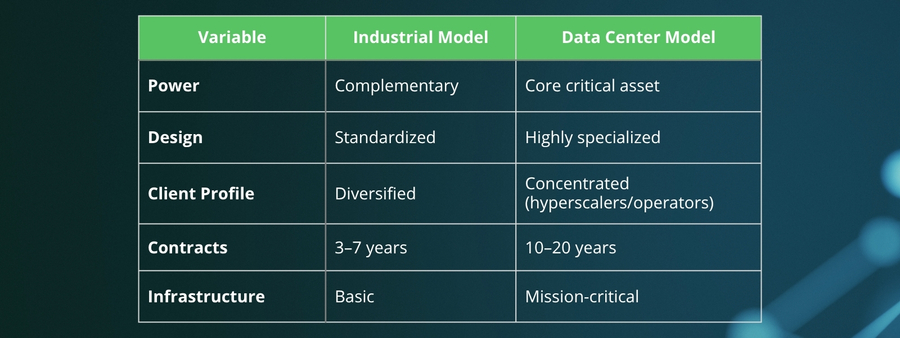
This shift gives rise to a new category:
Digital Infrastructure Parks, where turnkey development models play a central role.
– – – – – – – – –
Strategic positioning: Tijuana vs Traditional Markets
Tijuana does not compete directly with markets such as Querétaro or Monterrey. Its true benchmark lies with:
-
- San Diego
- Inland Empire
- Los Ángeles (overflow de edge capacity)
Comparative advantages:
-
- Same time zone as California
- Competitive latency
- Lower land and development costs
- Greater land availability
Primary challange:
- Energy infrastructure still evolving
– – – – – – – – –
Turnkey Projects: Enabling the Market’s Next Phase
At Turnkey Projects, we approach this market from a technical perspective by integrating three critical variables from the outset:
- Land suitable for data center campus development
- Strategic locations within the Tijuana region
- Energys feasibility analysis
- Scalable, phased project desing
Our objetive goes beyond lan commercialization. We focus on development platforms ready for digital infrastructure:

This approach reduces timelines, mitigates risk, and lowers barriers to entry form global operators.
– – – – – – – – –
Conclusión: Tijuana as an emerging Digital Infrastructure Node.
Tijuana combines two conditions rarely found together in emerging markets:
-
- True proximity to a Tier 1 market (California)
- Competitive latency for production workloads
The challenge is clear:
-
- Structured energy planning
- Technical planning
- Specialized execution through integrated models such as turnkey development
The market is evolving rapidly.
The question is not whether Tijuana will grow as a digital hub…
The question is who will be ready when demand crosses the border.
Let’s Connect
Are you involved in:
- Data center development
- Energy infrastructure
- Cloud or edge expansion
- Site selection
This is the moment to connect.