
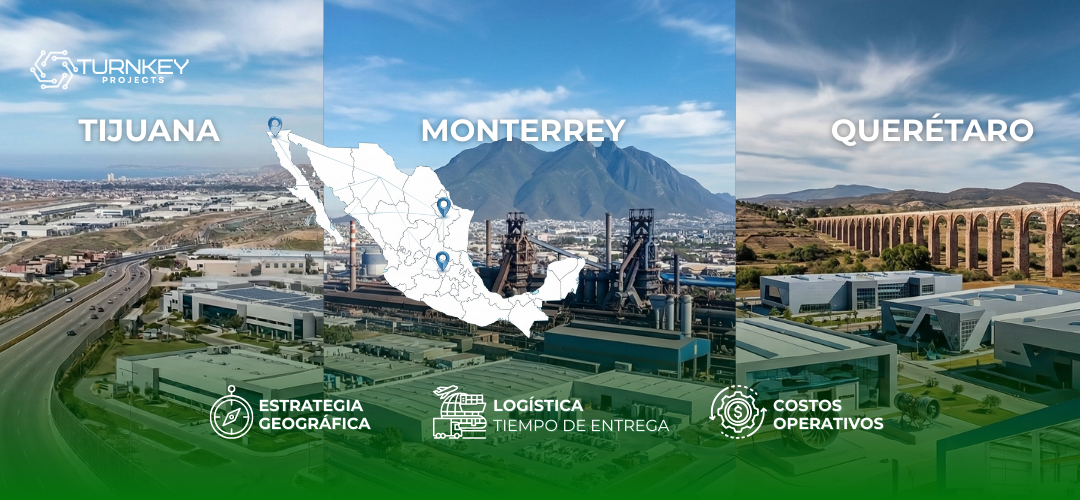
Tijuana vs. Monterrey vs. Querétaro:
Choosing the Right Manufacturing Location in Mexico
((2026 Strategic Comparison)
By Turnkey Projects — Industrial Development & Nearshoring Specialists
Mexico has become one of the world’s primary nearshoring destinations.
However, many foreign companies approaching the country ask the same question: “Where should we locate our operation?”
The answer is rarely simple.
Unlike smaller manufacturing markets, Mexico does not have a single dominant industrial region. Instead, it offers multiple specialized manufacturing corridors, each with distinct advantages.
Three of the most frequently evaluated regions are:
- Tijuana (Baja California — U.S. border)
- Monterrey (Nuevo León — Northern industrial hub)
- Querétaro (Central Mexico — Bajío aerospace & advanced manufacturing corridor)
This guide explains how each location functions operationally and which type of project aligns best with each region.
1: Geographic Strategy: Border vs Inland Manufacturing
The first decision a company must make is strategic: Is the operation logistics-driven or production-driven?
Border Model — Tijuana
Tijuana operates as a binational manufacturing platform integrated with Southern California.
-
- Key characteristic: Production in Mexico, engineering/logistics coordination in the United States.
- Typical industries:
-
- Medical devices
- Electronics
- Precision manufacturing
- Aerospace components
- High-value assembly
-
Primary advantage: Immediate access to the U.S. consumer and distribution market.
Northern Inland Model — Monterrey
Monterrey functions as Mexico’s traditional industrial capital.
-
-
Key characteristic: Large-scale manufacturing with strong domestic and supplier networks.
-
Typical industries
-
-
Metal.mechanic
-
Appliances
-
Automotive supplier
-
Heavy manufacturing
-
-
-
-
-
Primary advantage: Industrial infrastructure depth and supplier availability.
-
Central México Model — Querétaro
Querétaro is part of the Bajío manufacturing corridor and has emerged as one of the most sophisticated manufacturing regions in Latin America.
-
- Key characteristic: Engineering-oriented and export manufacturing with strong aerospace and automotive presence.
-
-
Typical industries:
-
-
Aerospace
-
Automotive components
- Advanced machining
- Technology manufacturing
-
-
-
-
-
Primary advantage: Engineering talent and structured industrial planning.
-
2: Logistics and Delivery Time to the United States
Nearshoring decisions are increasingly influenced by delivery speed.
| Location | Typical delivery time to U.S. market |
| Tijuana | Same day (hours) |
| Monterrey | 2 – 4 days |
| Querétaro | 3 – 5 days |
Border proximity allows companies in Tijuana to operate with lower inventory levels and faster replenishment cycles.
Inland locations require more logistics planning but may offer operational scale advantages.
3: Operating Cost Perspective
Real estate cost alone does not represent total operational cost.
| Factor | Tijuana | Monterrey | Querétaro |
| Industrial Rent | Highest | Medium | Medium-low |
| Transportation to U.S. | Lowest | Medium | Higher |
| Inventory Requirement | Lowest | Medium | Higher |
| Speed to customer | Fastest | Moderate | Moderate-slower |
| Supply Chain Depth | Medium | High | High |
Many companies discover that border logistics savings compensate for higher lease rates, particularly in high-value manufacturing.
4: Workforce and Talent Availability
-
-
Tijuana:
-
Highly experienced export manufacturing workforce
-
Strong in precision assembly and regulated industries
-
Competitive labor market (tight supply)
-
-
Monterrey:
-
Large labor pool
-
Industrial management experience
-
Strong technician base
-
-
Querétaro:
-
Engineering talent concentration
-
Technical universities and training centers
-
Stable workforce environment
-
-
5: Implementation Speed
Typical time from decision to operation:
-
-
Tijuana: Fastest when a building is available due to border supplier proximity.
-
Monterrey: Balanced implementation timelines.
-
Querétaro: Structured permitting but longer supply chain setup for U.S.-focused operations
-
6: When each location makes strategic sense.
Tijuana is optimal when:
-
-
The primary market is the United States.
-
Rapid delivery is essential.
-
Products are high value or time-sensitive.
-
Engineering interaction with U.S. teams is required
-
Inventory reduction is a priority.
-
Monterrey is optimal when:
-
-
Operations require large manufacturing scale
- Heavy industry or metal-mechanic processes are involved
- A strong local supplier ecosystem is necessary
- Domestic Mexican distribution is relevant
-
Querétaro is optimal when:
-
- Engineering talent is critical
- Aerospace or automotive precision manufacturing is involved
- Workforce stability is a priority
- Central Mexico logistics are required
Final considerations
The most common mistake companies make is selecting a city based solely on lease rates or incentives.
Successful nearshoring projects align location with operational strategy.
Mexico does not offer a single manufacturing solution — it offers multiple specialized platforms.
The correct question is not:
“Which city is best?”
The correct question is:
“Which location best supports the company’s supply chain model?”
Companies that answer that question properly achieve faster implementation, lower operational risk, and stronger long-term performance in Mexico.